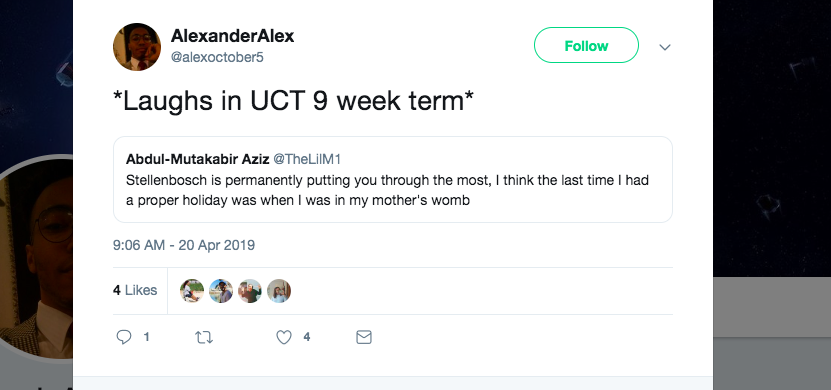
Caution, you are entering this term at your own risk. We are not responsible for any damage or harm that it may cause, including: higher levels of stress and anxiety, mental exhaustion, lower grades, physical exhaustion, lack of sleep, emotional exhaustion, multiple breakdowns and exhaustion.
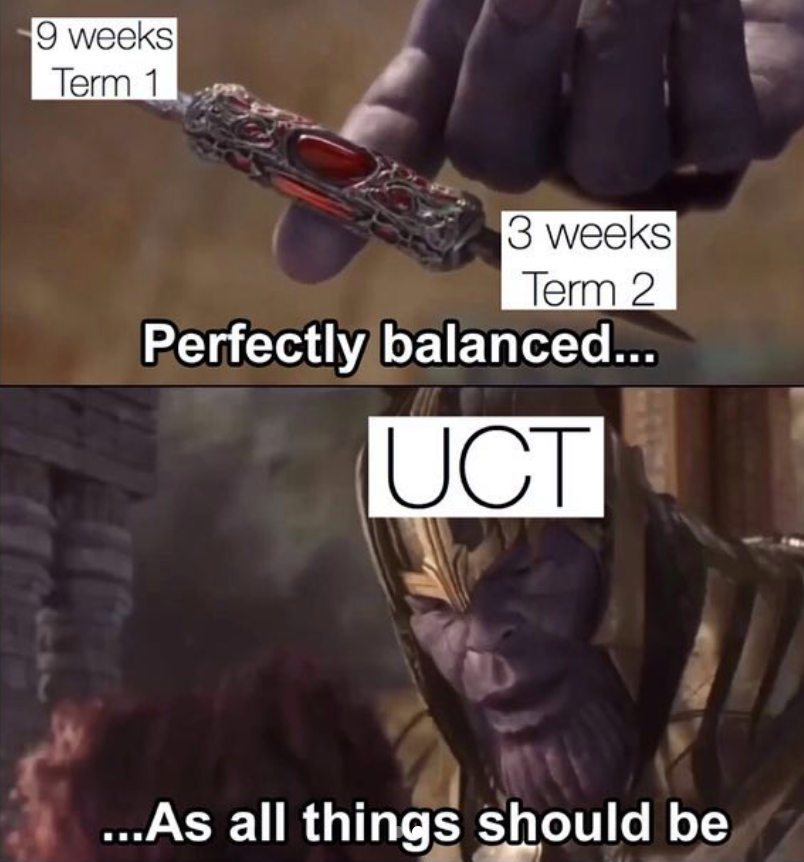
Firstly, before we dive into this spicy discussion, I would like to inform that I have written this article on the behalf of many of my UCT peers, social media opinions and comments made by UCT students, my tutors and of course, myself. Generally speaking, when asking a student about how their first term went, the general response tends to be something like: “challenging, but pretty good otherwise”, and it stops there. However, ask any UCT student about their first term of 2019 and expect to either hear a very long, angry, desperate, loud and heart-wrenching rant, or a very simple and traumatised “I don’t wanna talk about it”.
The University of Cape Town, the number one best ranked university in Africa and the 156th best ranked in the world, did something so out of the ordinary that its students would woefully remember for the rest of their lives. The 9 week term saw students crumbling at their utmost defeat on the Jammie stairs. The bursts of social media outcries and the significant decrease of campus attendance had allegedly resulted in the doings of the 9 week term. At this point in the year, forgiveness is definitely not on the table for UCT.

If you don’t know how the term structure works, don’t panic, I shall break it down for you. The general structure of the academic year is equally divided into 2 semesters consisting of 2 terms each, which amounts to a total of 4 terms in the year. Now, normally a semester is divided equally into a 6 week first term and a 7 week second term (the last week in term two is exam consolidation) with a short 10 day vac in between the 2 terms. This well-balanced and satisfactory calendar structure seems to suit and benefit its students, providing them an easily achievable 6 weeks of study and a 10 day break for a very much needed rest. In the current year of 2019, almost every public and traditional university in South Africa has continued to embrace this typical calendar structure, except UCT.
According to UCT’s document on the Guidelines for Academic Planning, the categories of qualifications such as Certificate, Diploma, Bachelor’s Degree and Bachelor (Honours) Degree presume a 30-week full-time academic year. The guideline further states that for such qualification types, it is expected and required that the average full-time student studies for + – 40 hours a week in order to fulfil the minimum credit-load requirement as per the qualification type. 40 hours of work per week equates to 360 hours of work for the full 9 week term and just less than 6 hours of work per day. If the semester was evenly split into its two terms of 6 weeks and 6 weeks, it would allow for a consistent and achievable work and study schedule. Impractically overloading the term with an extra 3 weeks amounting to 120 hours of studying after an already demanding 6 weeks prior, it has demotivated students leaving them mentally, emotionally and physically exhausted. By the 8th week, I saw a student starring at his black laptop screen for a solid 10 minutes, having only changed his leg placement once. That image pretty much summed up the term for me.

For the purpose of this very much needed discussion, I decided to conduct a survey for all UCT students on how they felt during and after the 9 week term. This was inspired by the cumulative hours spent scrolling through the never-ending Memes and humorous (yet also a desperate cry for help) videos that UCT JUST KIDDING provides for its students, as well as reading the numerous tweets from those who were frustrated and stressed. Hopefully the alarming results and comments from the survey will encourage an explanation.

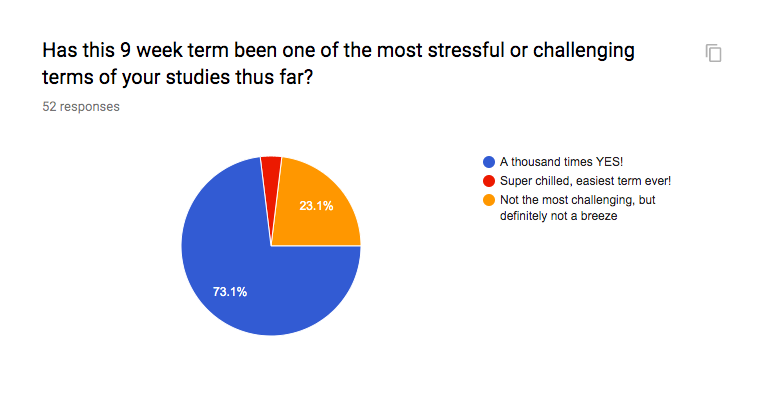
In the short space of 12 hours, a whopping amount of 52 UCT students responded to the “FEELS TOWARDS UCT’S 9 WEEK TERM” survey. As the survey was open to all UCT students, factors such as degree type and year of study did not determine the results. Graph 1 stipulates that 73.6% (39 students) felt that the term had been the most challenging and stressful term of their varsity career so far, with only 3.8% (2 students) feeling that it was the easiest. This first result already specifies the general consensus towards the term.
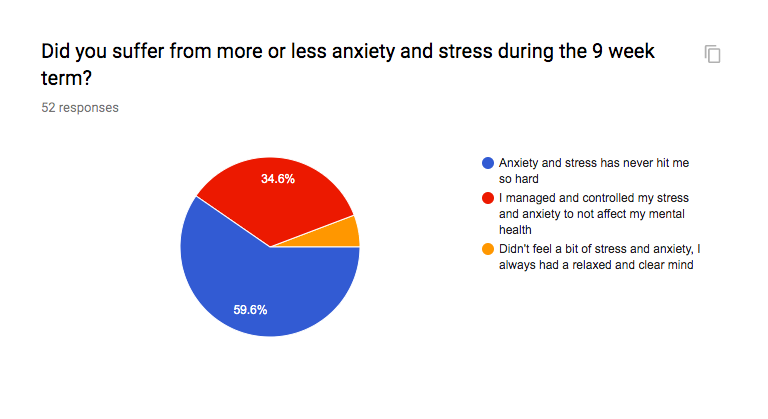
Graph 2 displays that 60.4% (32 students) felt that their stress and anxiety levels were higher in the long term, with only 5.7% (3 students) having felt no stress and anxiety, and for the 34% (18 students) who managed to control their mental health – please teach me how, or at least rub some of it off onto me! Mental health refers to the psychological state of one’s well-being. Looking after and putting your mental health first is something that UCT abides by. UCT has enforced support systems and services that are open and accessible to all students and staff members, which include counselling and therapy, 24-hour care lines, faculty support services, student wellness clinics on all campuses, and various wellness drives and workshops.
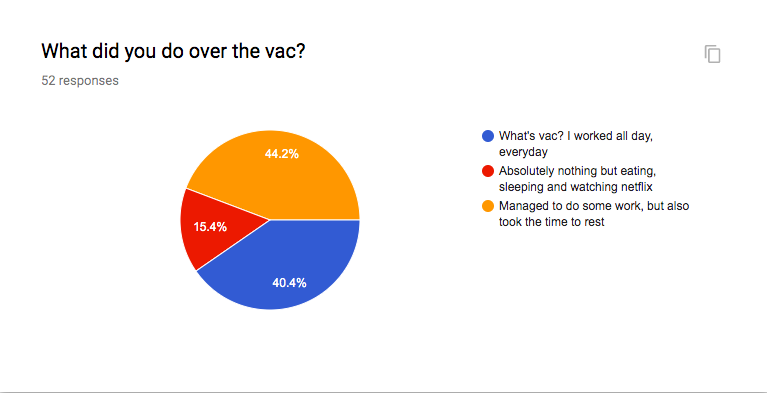
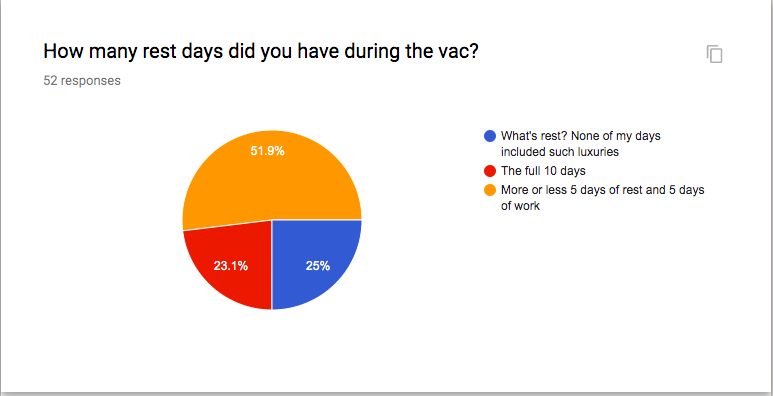
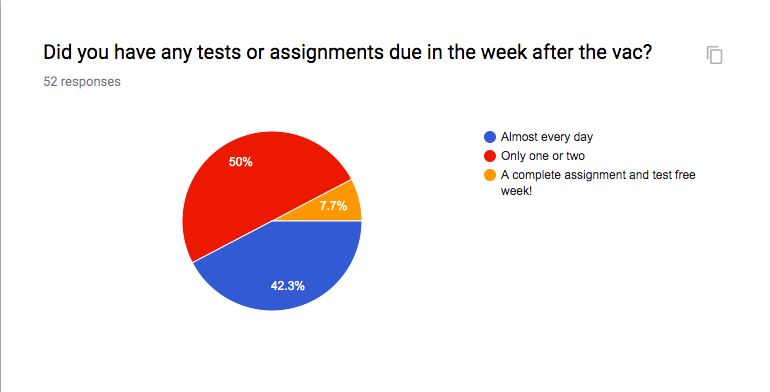
The mid-term break or short vac is essentially what gets students through the term as they look forward to having a well-deserved rest. Resting and relaxing is exactly what a holiday should entail. However, the results from Graph 3 show otherwise. 41.5% (22 students) worked or studied every single day of the mid-term short vac, and 43.4% (23 students) worked and rested. Although 15.1% (8 students) did nothing but rest, the number should be a lot higher considering the absolute need to rest after an extra 3 week longer term. Graph 4 complements this in showing that only 22.6% (12 students) took the full 10 days of vac to rest and relax, with 26.4% (14 students) having no rest days, and 50.9% (27 students) having rested for only half of the vac and working for the rest. The lack of rest during the vac cannot be attributed to the structure of the long term, however, it certainly takes its toll when the first week back in term two has scheduled tests, assignments and projects. Graph 5 stipulates that 43.4% (23 students) had tests or assignments due almost every single day in the first week back, and 49.1% (26 students) who had one or two during the week.
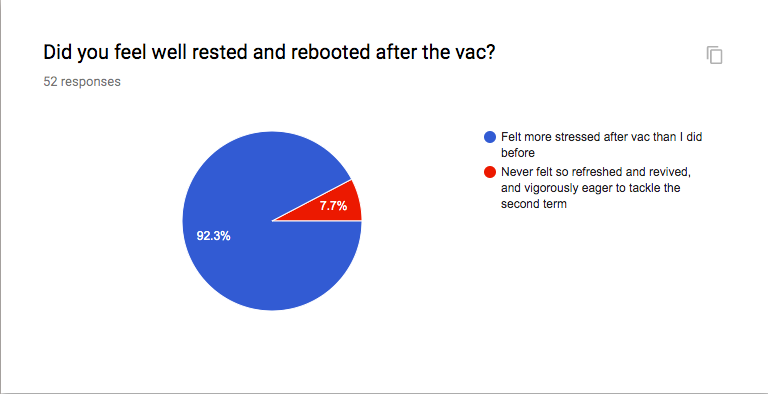
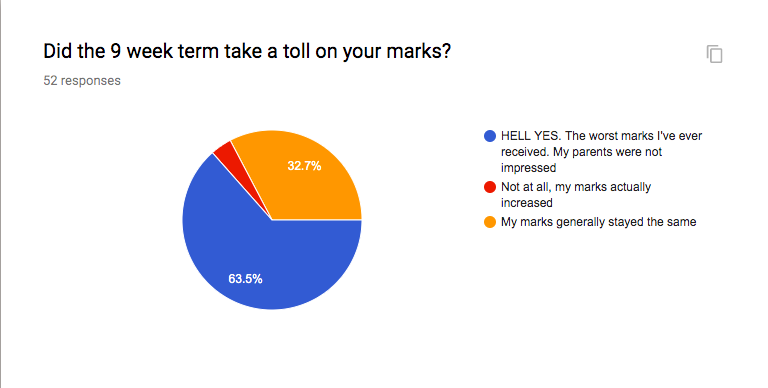
This brings me to a point of confusion. We are all expected to rest and take a break from academics in the vac after the demandingly long term, but also expected to prepare and study for the tests and assignments that immediately take place in the week after vac. This proposes two choices that seems to defy logic. One; use the vac to have a well-deserved and needed rest from the stressful 9 week term, and fail or do badly in the following weeks assessments. Two; use the vac to work and prepare in order to pass or do well in the following weeks assessments, and have your mental health suffer, as a result for not resting during the vac after the 9 week term. PLEASE TELL ME WHERE THE LOGIC IS. The fact that Graph 6 shows that 92.5% (49 students) felt more stressed after vac than before, proves my point that scheduling assessments in the week after vac and after a 9 week term takes a massive kick to most of the student’s mental health. Graph 7, showing a stressing amount of 64.2% (34 students) found that the long and academically demanding term took a massive toll on their marks and results, again proving that a longer academic term has multiple negative impacts on academic performance.
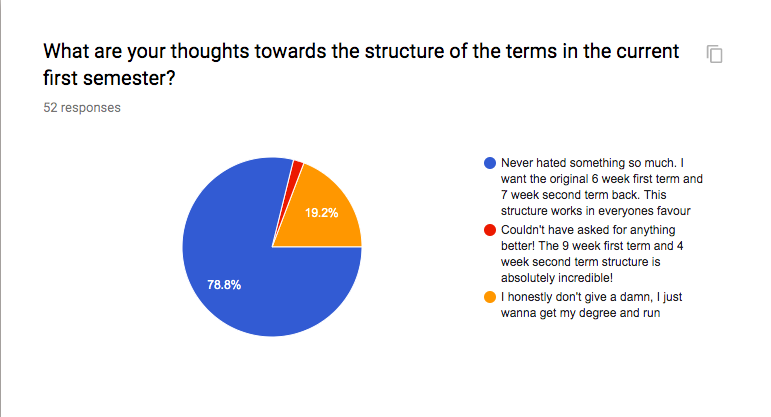
Finally, Graph 8 presents the students thoughts and opinions towards the implemented unconventional term structure, showing that 79.2% (42 students) have hated the structure and wish to have the conventional 6 weeks and 7 week terms back, with only 1.9% (1 student) in favour of the unconventional term structure. This ladies and gentlemen proves that the equal divide of the semester into the 6 weeks and 7 week terms works! It may not work for that one and only student (whoever you are, I hope you’re reading this), but for the majority, it works and always has.
By adding an additional 3 weeks to the end of the first term has shown to have a huge negative impact for the students. These extra 3 weeks even had the pigeons getting tired on campus. UCT, all we ask of you is to make it right again; for the sake of our academic performance, our sleep, our sanity, and lastly and most importantly; that no UCT student ever considers transferring to Stellies again.